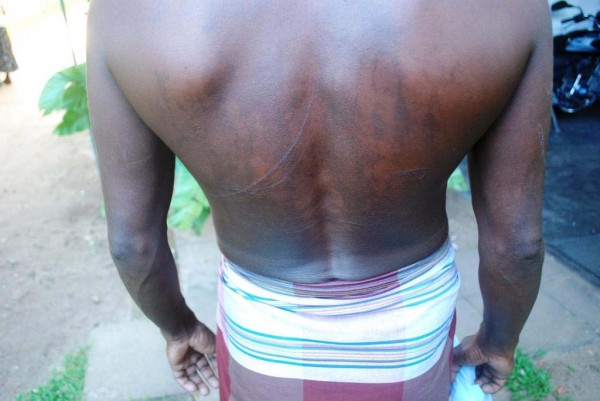
Police engage in torture, fabrication of charges and other illegal activities.
Even with this, they shelter super criminals.Now, star-labeled police officers respect infamous criminals in public.They behave in this manner, because they all are aware of the receiving of President Rajapaksha’s shelter, encouragements and blessings.
This is story about a pregnant woman called Renuka Malkanthi. As a result of assault Renuka Malkanthi faced severe bleeding is side the womb. Until now they don’t know the status of that unborn baby. The miserable policemen attached to Kiriella police do not care about such thingsKindly watch the full story - ''Is Cost of a baby in the womb Rs.20000? SL police fails to act.''
Mr. Vettuwel Wijayakumar (28) of Kallamale Estate, Bulathsinhala is married, a father of two and a labourer by profession.
On 11 December 2010 areound 11 am he went to the Bulathsinhala town to have a haircut. While he was waiting for his turn at the salon he observed that two policemen arrived by motorcycle. One of the officers asked Wijayakumar whether his name is Sinna and he told them that his name is V. Wijayakumar. The police officers arrested him and brought to the Bulathsinhala Police Station. At the police station he was presented with two documents that had already been prepared and was asked to sign them. Wijayakumar refused explaining that he did not know the contents of the documents and that he could not read Sinhala. At that time he was assaulted and again asked to sign the documents. He continued to refuse and the officers, one of whom was later identified as Police Sergeant Chithrananda, beat him with a hose pipe.
Sergeant Chithrananda dragged Wijayakumar to a room in the police station where they continued to beat him and pressuring him to sigh the book. Finally Wijayakumar complied out of fear of further assault. After they got his signature they kicked him out of the station.
When Wijayakumar left the police station Sergeant Chithrananda shouted at him not to go the home of Ms. Siriyawathi (whom he knew). As he had no idea of what the sergeant was talking about Wijayakumar went directly to her house. As she was not at home Wijayakumar went to the next home belonging to Mr. Renuka. Sometime later Ms. Siriyawathi arrived and Wijayakumar showed all the injuries he suffered due to the torture. All the people present were surprised and shocked and informed him that they did not have anything against him.
Then Siriyawathi went with Wijayakumar to the office of the Assistant Superintendent of Police (ASP) in Matugama to make a complaint against the assault faced by Wijayakumar. But the ASP told them to go to hospital for treatment and to come back another day as there were no officers to record his statement. So Wijayakumar went to Pimbura Government Hospital for treatment. At the hospital he revealed to the doctor that he was assaulted by policemen at Bulathsinhala Police Station. He was admitted to the hospital and then transferred to Nagoda General Hospital in Kalutara for further treatment. At the Nagoda Hospital his statement was recorded. He was discharged on 13 December 2010.
After he was discharged from the hospital, he made written complaints to Inspector General of Police (IGP), Human Rights Commission (HRC) and National Police Commission (NPC) and he is eagerly awaiting justice. The victim narrated the way he was tortured in the video link:- http://www.youtube.com/watch?v=gpzSpuBNlrI
Mr. Alahendra Acharige Dinesh Priyankara of Panadura North Police Division was a three wheeler diver. He was illegally arrested, detained and severely tortured by the OIC and officers of the Panadura North Police Station to force him to confess to a burglary at the newly constructed luxury house of a retired Deputy Inspector General of Police. He was tortured a second time in revenge for complaining against the police violation of his fundamental rights.
On 23 January 2011 around 6.30am while he was sleeping three police officers came to his home and knocked on his door. When he opened the door he saw two officers in front of his home and asked the reason for their visit. Without any explanation they told him to follow them to the Panadura North Police Station. He followed their instructions knowing that they were police officers as he has seen them before while he was traveling as a three wheeler driver.
Then they took him into the jeep and brought him to the police station. At the station they took him directly to a table. An officer came to him with papers and a pen while the two officers who arrested him sat on the both sides. Then the officer who brought the paper and the pen asked him where is the tiles belonging to the DIG were. Without warning they started to assault him with punches and kicks demanding that he tell the truth. He told them that he did not know anything about the DIG's tiles and explained that he is only a three wheeler driver and he knew nothing about such a case. Further he explained he that he parked his three wheeler at Gorakana Junction where he took on hires and that he had not stolen any tiles. He did, however, recall that he had gone for a hire to transport tiles from Gorakana Junction to First Lane in the same area. Further he told the officers that he can easily show the person who hired his three wheeler for transporting the tiles and where they were delivered to.
Then the officers locked him up in the cell. After a while the officers took him to the place where he unloaded the tiles and the officers took some of them as evidence. Then they took him back to the police station along with tiles and locked him up in a cell.
After a while the officers took him again out from the cell and brought him to the back side of the police station where again he was assaulted. Dinesh told the officers that usually he is being called for hires by the officers and the workers of that said DIG's site. Further Dinesh explained that a man called Danushka told him that he is transporting these tiles from one site to another as they belong to him. That was the reason to go for that hire.
Then again he was brought to the Officer-in-Charge (OIC) office whom he later learned was Mr. Ramya De Silva. He noted that there were two persons in that place. These two people were in conversation with the OIC. Following the conversation he understood that both of them are assistants of the DIG. They were from the same village as Dinesh.
When Dinesh was brought before these two persons they told the OIC that he was from the same village and he never engaged in crime. They further said that they know Dinesh very well but the OIC then started to beat him in front of them. Then the two assistants of the DIG checked the tiles that were brought in and told the OIC that they were are not the tiles that were stolen.
Without considering their refusal of identity of the tiles the OIC ordered to take Dinesh into the jeep. Then the officers drove the jeep to the Nugegoda along with Dinesh. Dinesh was brought to a site where he noted that a few officers were working in construction work. He was asked to check the identity of the workers and Dinesh immediately identified the person who called him for transportation of tiles, Mr. Danushka. After Dinesh pointed to Danushka officers asked him to go to the rear sheet of the jeep. Then officers went and arrested the Danushka as well. Then officers drove back to the police station again.
At the police station Dinesh was again locked Dinesh up in cell and Danushka was brought to the back side of the police station where Dinesh was beaten earlier occasion. Then he noted that Danushka was brought back to the OIC's office. Dinesh was also then brought back to the OIC's office. Then the OIC and other officers started to beat him again.
Meanwhile Dinesh saw that his mother also have come to the police station. Further he noted that officers chased away her when she tried to come and rescue Dinesh by explaining his innocence to the officers. But Dinesh noted that through the window his mother watched the way he was tortured.
Dinesh noted that one officer had a paper. Dinesh noted that few officers of the DIG's company were sitting with OIC. One officer of the company was seated on the chair of the OIC. The OIC who wore two stars on his epaulets was seated next to him. Dinesh noted that the station officers were drunk and that the company men were treated them with alcohol.
Then the OIC asked Dinesh to tell the truth again. Dinesh told the OIC the same story and repeated that he had never engaged in stealing and he only went for a hire at the request of Mr. Danushka. He clearly indicated Danushka who was in front of all of them. Then the OIC told Danushka that if Dinesh was lying to assault him. But Danushka did not do so. The OIC told Danushka that if he did not assault Dinesh they would severely beat Danushka. Upon hearing this Danushka made a light assault on Dinesh's shoulder. When he saw this, the OIC again shouted and gave him a pole and ordered him to beat Dinesh about the head until he died. However, Danushka refused to assault Dinesh.
Then the OIC blamed Dinesh with obscene language saying that his mother had gone to the Human Rights Commission (HRC) to make complaint against police officers. He further told Dinesh that his mother had gone to the officers of the HRC to allow them to have intercourse with her. Dinesh realised that the OIC extremely angry that his mother has gone to complain against them. Then one of the officers told Dinesh that Danushka had provided a paper stating that it was Dinesh who stole the tiles. Dinesh vehemently denied it. But he understood the officers wanted to take revenge from him for his mother's complaint to the HRC.
Then again the OIC started to kick him and as a result Dinesh fell to the ground. Immediately he noted that his nose was bleeding. Then the OIC trampled on his arms while two other officers trampled on his legs. When the OIC noticed that Dinesh's nose was bleeding and asked him to get up. The OIC again tried to force Dinesh to accept the crime which Dinesh again refused.
Then one officer asked him to sign a document prepared by the officers. It was not recorded from him or the contents explained to him. Out of fear and pain he signed the document. The officers forced Dinesh to put a finger print to the document.
Then Dinesh was told that now the officers can file any amount of fabricated charges.
Next day he was brought back to the OIC's office. The OIC started to complain about the Magistrate with obscene language and shouted that if they produced Dinesh in the daytime then the Magistrate would grant bail to him therefore he intended to produce Dinesh after the sessions of the court were completed.
In the evening he was brought to the Magistrate's Court of Panadura. Even before he was produce before the Magistrate he was asked to sign another document in the same manner. Dinesh was produced before the Magistrate who granted him bail. While releasing him on bail the Magistrate ordered the DMO to produce him a Medical Report on his condition.
After he was released immediately the mother brought Dinesh to the hospital and the doctor admitted him for further treatment.
Dinesh stated that police tortured him at the whim and fancy of the former Deputy Inspector General (DIG) of Police who was building a massive house at the bank of Bolgoda River in the same area. The victim has narrated his story in the video
Growing Concern Over The Wide Spread Use Of Torture In Sri Lanka
The Asian Legal Resource Center (ALRC) has expressed grave concern at the widespread and endemic use of torture in Sri Lanka and the lack of credible government action to combat it.
The comments were made in a written claim in a dialogue with the special rapporteur on torture at the 16th sessions of the UN Human Rights Council in Geneva.
It said the government has failed to implement the many recommendations made by the UN human rights system, notably the Special Rapporteur on Torture, the Committee Against Torture and the Universal Periodic Review.
Police Torture
Janasansadaya is an organisation that works towards a ‘torture free Sri Lanka’. Its secretary, Chitral Perera, told The Sunday Leader that “torture is especially serious in the South. People are routinely assaulted in police custody. Mostly they are hung by their fingers and beaten up. Another favorite is beating the bottom of the heels, the head and the body. Rubber hose is used to cushion the blows, ensuring that the damage is internal and minimising marks on the outside”. He also outlined several other methods like water boarding, petrol soaked polythene suffocation and other methods involving liquid chilli powder that are too grim to mention.
Perera says that the victims are often arrested for no reason. “Extortion is a common motive for the police but an even more common one is the filling of quotas” says Perera, adding that the police routinely ‘pick people off the streets’ and make them confess to crimes like drug running, robberyand so on under the strain of torture. “They often make fake cases against people and then produce them in courts” says Perera.
Sometimes torture victims seek justice against the police. In such cases, according to Perera, they are threatened and bullied into dropping these cases by the police. “They sometimes use people like relatives, religious leaders and politicians to get them to drop the cases”. Janasansadaya has highlighted several cases of torture on its website (janasansadaya.org) and have detailed interviews of victims for public perusal.
System is not victim friendly
According to Perera, victims of torture get a bad deal wherever they turn. “Torture victims are first sent to hospitals and then sent to courts. And especially in the peripheral hospitals, doctors issue reports without properly examining these patients. Even lawyers who are supposed to defend them do not bring up the issue of torture in courts. It is a crime that is occurring with the implicit approval of all involved.”
“Law and order has broken down” he says, adding that “no probable political motive exists here. These things are done at the behest of the police because they have been allowed to run wild. The government has sanctioned it by turning a blind eye.” He thinks it’s a strategy to control the country’s people and keep them in check.
However, the Police Spokesperson Prishantha Jayakody, speaking to The Sunday Leader said “all these reports of torture are unfounded. They are lies told by people who have nothing else to do. If torture was really taking place then these victims can use their constitutional rights to claim justice”.
State of Human Rights
The ALRC Submission said that the issue of torture is a key indicator of the state of human rights in Sri Lanka. It urged the members of the Human Rights Council to ensure that the Government of Sri Lanka takes credible steps to put an end to the system of torture and impunity that it currently operates within. The steps it recommended include adopting a definition of torture that covers all the elements contained in Article 1 of the UN Convention Against Torture and strengthening the Human Rights Commission of Sri Lanka.
It also asked the government to “ensure prompt, impartial and exhaustive investigations into all allegations of torture, ill-treatment and disappearances committed by law enforcement officials” by urgently implementing measures to eradicate impunity and to provide justice to torture victims. It asked the government to “impose appropriate sentences on those convicted, thus eliminating any idea that might be entertained by perpetrators of torture that there is impunity for this crime.”
Other recommendations included the setting up of a programme to monitor, counsel and treat torture victims and the establishment of independent monitors such as Human Rights Watch in the country. The Asian Legal Resource Centre (ALRC) is an NGO having General Consultative status with the Economic and Social Council of the United Nations. It was founded in 1986 by a group of jurists and human rights activists in Asia.